



[responsivevoice_button voice=”US English Male” buttontext=”listen”]
THE LONG VOYAGE HOME: HOW THE VOYAGER PROBES REDEFINED OUR PLACE IN THE UNIVERSE
In 1977, humanity launched two of its most ambitious creations: Voyager 1 and Voyager 2. Designed to take advantage of a rare planetary alignment that occurs only once every 175 years, these probes were sent on a grand tour of the solar system, with a mission to explore Jupiter, Saturn, Uranus, and Neptune.
What started as a four-year mission of planetary exploration has since become one of the most enduring and inspiring journeys in the history of science.
The Voyager probes were not just marvels of engineering; they were vessels of hope and curiosity. Each carried a “Golden Record,” a phonograph record containing sounds and images selected to portray the diversity of life and culture on Earth.
From the greetings in 55 languages to the sounds of a humpback whale and Chuck Berry’s “Johnny B. Goode,” these records were a time capsule, a message in a bottle cast into the cosmic ocean for any future civilizations that might find it.
Their initial mission was a stunning success. Voyager 1 provided us with breathtaking images of Jupiter’s Great Red Spot and the volcanoes of its moon, Io. It then went on to capture the magnificent rings of Saturn.
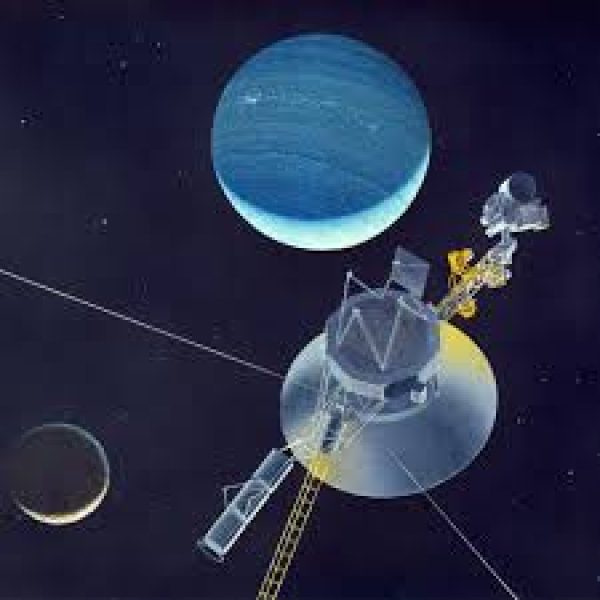
Voyager 2, meanwhile, became the first and only spacecraft to visit Uranus and Neptune, revealing the mysterious, icy giants in unprecedented detail. It discovered previously unknown moons, rings, and the Great Dark Spot on Neptune, a storm the size of the Earth.
But their story didn’t end there. As they completed their planetary flybys, the probes began a new, even more profound chapter: their voyage into interstellar space.
For decades, they journeyed through the heliosphere, the protective bubble of charged particles created by our Sun. The boundary of this bubble, the heliopause, marks the edge of our solar system’s influence. Crossing it would be humanity’s first step into the space between the stars.
The moment came on August 25, 2012, when Voyager 1 officially crossed the heliopause. Scientists at NASA’s Jet Propulsion Laboratory monitored a sudden and dramatic change in the particle environment around the probe.
The steady stream of solar particles was replaced by a surge of galactic cosmic rays, evidence that Voyager 1 had entered the interstellar medium. It was a historic moment, confirmed by subsequent data that showed the probe was now in a different magnetic field, one originating from the galaxy itself, not our Sun.
Today, both Voyager 1 and Voyager 2 continue to operate, with their mission extended far beyond their original design. They are now the most distant human-made objects in the universe. They continue to send back vital data, providing the first-ever direct measurements of the interstellar medium—the cosmic sea of particles and fields that permeates our galaxy.
This data is helping us to understand the nature of the space outside our solar system, information that is crucial for future interstellar travel and our understanding of the universe.
The Voyager probes are more than just instruments; they are a testament to human ingenuity and the unquenchable thirst for discovery. Their journey reminds us that our home is just one small corner of a vast and magnificent cosmos.
As they travel through the dark, cold vacuum of space, carrying their Golden Records into the unknown, they are a powerful symbol of our potential and a beacon of hope, reminding us that even the longest journey begins with a single, inspiring launch.
They show us that our place in the universe is not just on Earth, but wherever our curiosity takes us.
#Voyager
#Voyager1
#Voyager2
#NASA
#SpaceExploration
#Interstellar
#GoldenRecord
#Space















 Page Looksograph